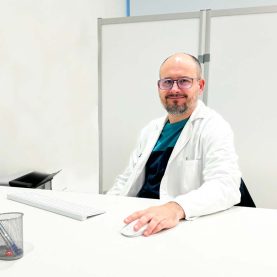
Dr. De Castro, Francisco Javier
Facharzt für Radiologie und Innere Medizin




Find out how your body is really ageing
Biological age does not always coincide with chronological age, which is determined by the date of birth.
Biological age reflects the rate at which our body ages at the cellular level. It can be lower, the same or higher than chronological age and is influenced by our lifestyle, habits and health status.
If our biological age is lower than our chronological age, we are on the right track. If our biological age is higher, we should consider changes in our habits and care.
The epiAge test is a biohacking and preventive tool that provides real data to lead a longer and better life.

The epiAge test allows you to find out how your body is really ageing, detect premature ageing and personalise strategies to improve your health and longevity.


This test does not constitute a medical diagnosis, nor does it predict life expectancy. It is an informative tool intended to improve and motivate your self-care.
The epiAge test is one of the most advanced tools for measuring what we call biological age. Unlike other methods, it uses Next Generation Sequencing (NGS). This makes it much more stable and reliable for long-term monitoring.
The calculation is done through DNA methylation. Although all the cells in your body have the same instruction manual (i.e. the same DNA), they do not all perform the same functions. This is due to epigenetics.
Methylation is like placing chemical stickers (methyl groups) on DNA, especially in certain regions called CpG sites. Methylation markers indicate the specific positions or patterns where these stickers are placed (or not placed), revealing whether a gene is on or off, without altering the DNA sequence itself.
As we age, methylation patterns change in predictable ways across thousands of sites in the genome. Hence the concept of the epigenetic clock: scientists have identified specific sets of these sites (known as CpG sites) that serve as reliable markers of ageing. By analysing their status, it is possible to estimate a person’s biological age.
The first epigenetic clock was created by researcher Steve Horvath in 2013 and showed that certain chemical “switches” in our genome follow a very precise ageing pattern. Since then, other studies have confirmed that these clocks not only predict age with high accuracy, but are also linked to future health: a biological age higher than chronological age is often associated with a greater risk of disease and shorter life expectancy. In contrast, healthy habits such as exercise, good nutrition and stress reduction can help the epigenetic clock indicate a younger age.
Biological age based on DNA methylation is calculated by analysing chemical patterns in the genome that change over time; these patterns function as an “epigenetic clock”, scientifically validated by numerous studies.
A DNA sample is collected (usually from saliva or blood).
This is analysed using laboratory techniques such as microarrays or bisulphite sequencing, which detect the degree of methylation at relevant CpG sites.
The data is input into statistical algorithms trained on large population cohorts.
The result is an estimate of epigenetic age, which may differ from chronological age depending on factors such as lifestyle, diet, stress or disease.
The result is an estimate of the epigenetic age, which may differ from the chronological age depending on certain factors, especially the four fundamental pillars:
- Diet and supplementation
- Sleep quality
- Physical activity
- Stress management
We cannot change our age, but we can change how our body ages.
Dr. De Castro, Francisco Javier
Facharzt für Radiologie und Innere Medizin

Dr. Martín, Nicole
Spezialist in der inneren Medizin bei HC Marbella

Dr. Iglesias, Wilfredo
Spezialist in der inneren Medizin bei HC Marbella

Dr. Reisbeck, Manuela
Spezialist in der inneren Medizin bei HC Marbella

Dr. Lebrón Ramos, Juan Manuel
Especialista en Medicina Interna de HC Marbella
Médico de Urgencias
Tel.: +34 952 908 628
+34 609 148 799
952908898 Onkologie
951829978 Bildgebende Diagnostik
951829947 Gynäkologie
952908897 Fertilitäts-Zentrum
951829947 Physiotherapie