
World Alzheimer’s Day reminds us of the importance of raising awareness and advancing the early detection of this disease, which affects millions of people worldwide.
Detecting Alzheimer’s disease in its initial stages is a major challenge. Very often, the first symptoms, such as minor forgetfulness or changes in behaviour, are mistaken for normal ageing.
An early diagnosis can make all the difference, as it enables us to start treatment sooner, plan care more effectively and improve the quality of life for both patients and their families.
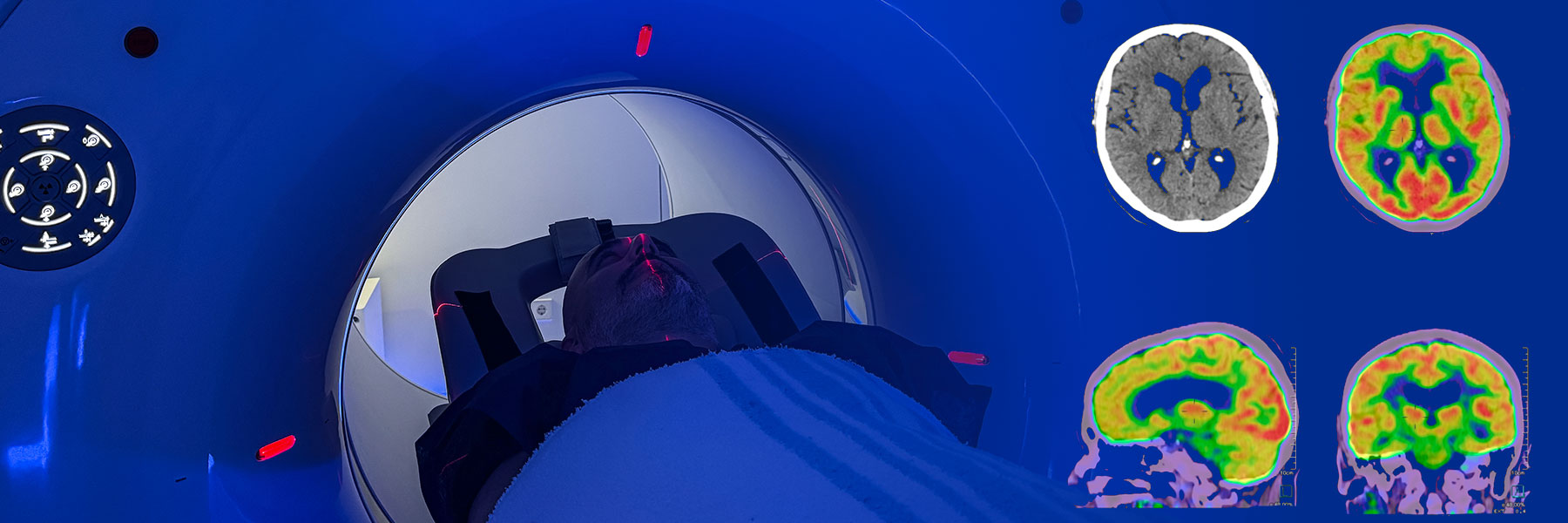
One of the most advanced tools available to help achieve this is a neurological PET-CT scan.
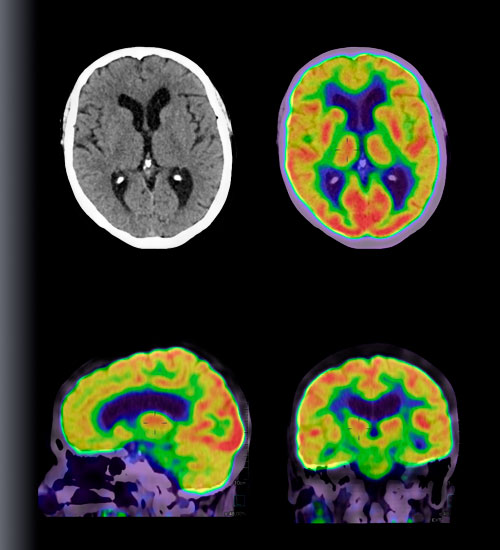
PET-CT (positron emission tomography combined with computed tomography) is an imaging technique that allows us to observe how the brain functions, not just its structure.
During this procedure, small amounts of tracers are administered. These are substances that travel through the bloodstream to the brain and make certain processes visible.
- FDG (fluorodeoxyglucose) PET scan: measures how brain cells use glucose, their source of energy. In Alzheimer’s disease, certain areas show reduced activity and consume less glucose, which is clearly visible on the scan.
- Amyloid or tau PET scan: the tracer binds to abnormal proteins that accumulate in the brain.
- Amyloid is deposited, forming plaques between the neurons.
- Tau accumulates inside the neurons in the form of tangles.
These deposits are characteristic of Alzheimer’s, and detecting them via PET helps to confirm that the patient’s symptoms are due to this disease and not to another form of dementia.
Put simply: FDG-PET scan shows whether the brain is ‘using less energy’ in certain areas, while amyloid or tau PET scan reveals whether the proteins typical of Alzheimer’s are already present. Thus, these scans enable a more accurate and earlier diagnosis.
1. IDEAS study (USA)
This study involved 16,008 patients and showed that an amyloid PET scan can lead to changes in both diagnosis and clinical management, particularly in patients with mild cognitive impairment (MCI) or dementia of uncertain cause. Patient management changed in 60.2% of patients with MCI and 63.5% of those with dementia.
Rabinovici, G. D., Gatsonis, C., Apgar, C., et al. (2019). Association of Amyloid Positron Emission Tomography With Subsequent Change in Clinical Management Among Medicare Beneficiaries With Mild Cognitive Impairment or Dementia. JAMA, 321(13), 1286–1294. doi:10.1001/jama.2019.2000
2. Study by the Clínica Universidad de Navarra
This study evaluated the clinical utility of amyloid PET and FDG-PET scans in predicting progression to Alzheimer’s disease in patients with amnestic mild cognitive impairment (aMCI):
- A positive amyloid PET scan indicates a higher risk and faster progression.
- A positive FDG-PET scan detects brain changes typically associated with Alzheimer’s disease.
- Together, both scans provide a more accurate and earlier indication of who may develop Alzheimer’s, helping to plan care and treatments from the earliest stages.
A doctor may recommend a neurological PET-CT scan in scenarios such as:
- Diagnostic uncertainty in patients with memory loss or other cognitive symptoms.
- Differentiating between Alzheimer’s and other types of dementia.
- Assessment of patients with mild cognitive impairment where a neurodegenerative cause is suspected.
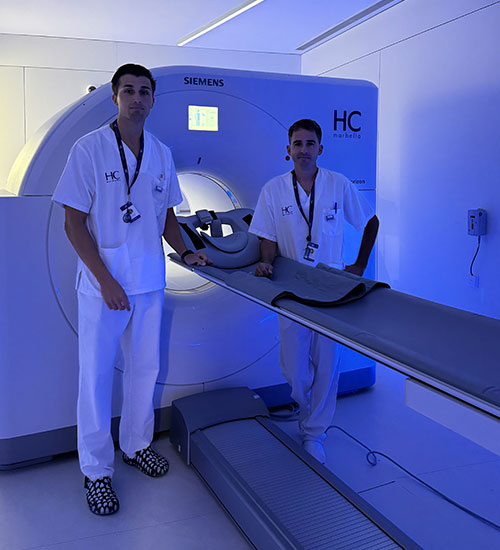
At HC Marbella, we feature a state-of-the-art PET-CT scanner, designed specifically for the investigation of neurological conditions. Thanks to this technology, early diagnosis of Alzheimer’s and other dementias is achievable, providing precise and reliable information that facilitates medical decision-making.
The combination of technological innovation and personalised care enables us to offer our patients a safe experience, without long waiting times, and with the peace of mind that comes from being in expert hands.

Dr Luis Villar
Specialist in Nuclear Medicine
September 21, 2025
Read other news
Tel.: +34 952 908 628
+34 609 148 799
952908898 Oncology
951829978 Diagnosis by imaging
951829947 Gynecology
952908897 Fertility
951829947 Physiotherapy